

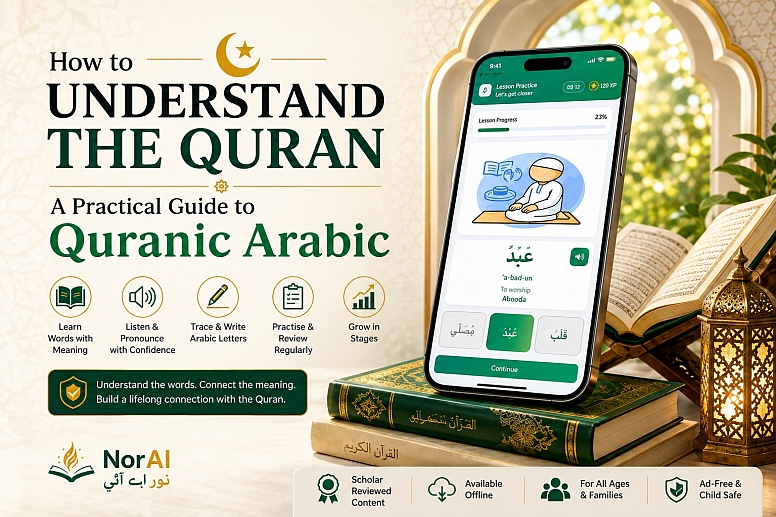
Understanding the Quran: A Practical Guide to Quranic Arabic
To begin understanding the Quran more directly from its Arabic text, start by building familiarity with Quranic Arabic words and their basic meanings, then gradually learn how those words function within phrases and verses.
You do not need to master advanced Arabic before beginning, but regular vocabulary review, listening, reading, and guidance from qualified teachers and scholars can help create a stronger foundation.
Understanding the Quran develops in stages. Recognising individual Quranic words is an early step, while grammar, context, tafseer, and deeper interpretation require further study and appropriate scholarly guidance.
Learning Quranic Arabic can deepen your connection with the Quran, but you do not need to understand every word before reading and reciting it. Muslims can continue reading and reciting the Quran while gradually developing their understanding through Arabic study, translation, tafseer, reflection, and learning from qualified scholars.
What Does It Mean to Understand the Quran?
Understanding the Quran involves developing greater awareness of the Arabic words, meanings, grammatical relationships, and context found in the Quran.
For a beginner, this often starts with Quranic vocabulary.
A learner may first recognise common nouns, verbs, pronouns, particles, or connecting words. As those words become familiar, parts of a verse can begin to carry recognisable meaning instead of being experienced only as Arabic sounds.
There is also an important distinction:
Quranic vocabulary helps you recognise Arabic words and understand their basic meanings.
Tafseer explains the meanings of Quranic verses using the Quran, Sunnah, Arabic language, relevant context, and the explanations and principles established by qualified scholars.
Knowing several words in an ayah can improve comprehension, but it does not automatically give someone the knowledge required to interpret that ayah independently. The meaning of a Quranic verse cannot always be established simply by combining the dictionary meanings of individual words.
NorAI is a structured Quranic Arabic learning app focused on developing word recognition and language understanding. Its curriculum progresses from Arabic reading foundations into nouns, pronouns, connectors, Quranic verbs, word relationships, and increasingly contextualised Quranic examples.
Why Is Quranic Vocabulary Important for Understanding the Quran?
Quranic vocabulary matters because words are among the first elements of meaning a learner begins recognising directly in the Arabic text.
Imagine reading a verse in which every Arabic word is unfamiliar. You may be able to pronounce it correctly while still relying completely on a translation to know what it means.
After studying Quranic vocabulary, the same verse can feel different.
You may recognise a familiar noun. A verb may remind you of an action you previously studied. A pronoun or connector may help you notice how one part of the text relates to another.
You may still need a translation and scholarly explanation, but the Arabic itself is beginning to become more familiar, allowing you to recognise words and parts of the meaning directly from the text.
Familiarity changes the reading experience
A word usually becomes more useful when you can recognise it again, not simply when you have seen its translation once.
This makes vocabulary retention more important than vocabulary collection.
A learner who studies a manageable group of words and remembers them may develop more useful recognition than someone who repeatedly studies large lists but forgets most of them.
This principle is built into NorAI's learning model. The app separates completing a lesson from retaining its vocabulary. Studied words can move through New, Learning, Review, and Mastered stages as they are recalled over different sessions.
That creates a useful distinction:
Completion measures activity. Mastery measures retention.
How Can You Start Understanding the Quran?
You can begin with a structured process rather than trying to learn everything at once.

1. Build a reliable Arabic reading foundation
If Arabic letters, vowel marks, basic sounds, or joined forms are still difficult, strengthen those skills first.
You do not need perfect fluency before learning vocabulary, but recognising the written form of a word makes vocabulary study much easier.
NorAI's first curriculum stage follows this progression by beginning with letters, sounds, marks, joining, and early Quranic word recognition.
2. Learn Quranic words in meaningful groups
Avoid treating Quranic Arabic as one enormous vocabulary list.
Organising words into categories can make the learning process easier to follow.
Useful categories include:
-
nouns
-
pronouns
-
particles and connectors
-
verbs
-
common word relationships
NorAI's structured curriculum follows a similar progression across its learning stages rather than introducing every type of Quranic word at the same time.
3. Learn the Arabic form, sound, and meaning together
A word has more than one learning cue.
Look at its Arabic form. Hear how it sounds. Learn its basic meaning and practise recognising how it is used in Quranic context. Then practise recognising it without immediately seeing the answer.
This gives the learner several ways to remember the same vocabulary.
Audio recognition can be particularly useful because Quranic words are frequently encountered through recitation as well as reading.
NorAI includes listening activities where learners hear a studied Arabic sound or Quranic word and identify the matching option. Its Audio Practice is intended for listening recognition rather than formal Tajweed instruction.
4. Review old vocabulary before adding too much new material
New words can make a study session feel productive, but recognition is built through repeated exposure and review.
After learning a word, test it again later.
Ask:
-
Do I recognise the Arabic without seeing the English?
-
Can I remember its basic meaning?
-
Can I recognise the word when I hear it?
-
Do I notice it when I encounter it again?
-
Can I recognise how the word functions when it appears in a Quranic context?
A word that repeatedly survives these checks is becoming genuinely familiar.
5. Look for learned words inside Quranic context
Once individual words become familiar, start noticing them when reading Quranic text.
The purpose at this stage is recognition and developing familiarity with the language.
You might notice a known verb, connector, pronoun, or noun inside an ayah and recognise a small part of the language that previously looked unfamiliar.
NorAI's later curriculum stages similarly move learned forms into phrases and increasingly contextualised Quranic examples rather than leaving all vocabulary isolated.
Recognising familiar words can help build a foundation for deeper understanding, but the complete meaning of an ayah may depend on grammar, context, the relationship between words, and explanations found in tafseer.
6. Study deeper meaning through appropriate scholarship
Vocabulary gives you greater access to the language of the Quran, but it should not be confused with interpretation.
Use qualified teachers, recognised tafseer works, and guidance from knowledgeable scholars when studying the wider meaning or implications of verses.
A useful learning path is therefore:
Reading → Vocabulary → Recognition → Grammar & word relationships → Quranic context → Deeper scholarly study
This approach allows language learning to support Quranic understanding without treating basic vocabulary knowledge as a substitute for tafseer or qualified scholarship.
Common Mistakes When Learning Quranic Arabic
Trying to progress too quickly
Covering more vocabulary is not automatically better.
If previously studied words disappear from memory as quickly as new ones are introduced, the learning system is creating completion rather than retention.
Regular revision should be part of the curriculum rather than something left until the end.
Studying translation without the Arabic word
If the goal is Quranic Arabic recognition, the Arabic form should remain central.
Seeing only an English translation may teach the general meaning of a passage, but it does not necessarily help you identify the original Quranic word later.
Translation can be a valuable aid to understanding, but it should not be confused with the Arabic Quran itself. Studying the Arabic alongside an appropriate translation can help learners connect the original words with their translated meanings.
Assuming one correct answer means a word is learned
Short-term recall can be misleading.
A word that feels easy immediately after studying may become difficult after several days.
Review across separate sessions gives a more useful picture of whether recognition is becoming stable.
Treating word meanings as complete interpretation
Individual word recognition is valuable, but Quranic meaning also involves grammar, syntax, context, rhetoric, relationships between words, and scholarly interpretation.
Knowing the vocabulary should encourage deeper study rather than create overconfidence.
A learner should therefore avoid concluding that knowing the basic meaning of several words in an ayah is enough to determine its complete interpretation or legal, theological, or practical implications.
Using only one type of practice
Different activities reveal different weaknesses.
A learner may recognise a written word but fail to identify it by sound. Another may remember its meaning but struggle to recognise its Arabic form.
Combining reading, listening, visual recognition, writing, matching, and recall provides more opportunities to test whether a word is genuinely familiar.
NorAI uses several guided practice types, including Visual Learning, Articulation Practice, Audio Practice, Writing Practice, Match Quiz, and Word Joining.
A Useful Principle for Quranic Arabic Learning
One useful way to evaluate progress is:
Do not measure Quranic vocabulary only by how many words you have studied. Measure how many you can recognise again without being shown the answer.
This shifts the focus from volume to retention.
It also explains why repeated encounters with familiar vocabulary are useful. The aim is for Quranic words to require progressively less effort to recognise when they return.
At the same time, vocabulary recognition is one part of a wider process. Deeper understanding requires continued study of Arabic language, grammar, context, tafseer, and the guidance of qualified scholars.
Frequently Asked Questions
How can I understand the Quran if I do not know Arabic?
You can begin with a reliable translation while gradually learning Quranic Arabic vocabulary. Learning common words will not replace translation or tafseer, but it can help you recognise more of the language directly from the Arabic text over time.
You can also continue reading and reciting the Quran while learning. Understanding Arabic is a gradual process, and a person does not need to wait until they have mastered Arabic before benefiting from recitation, translation, reflection, and study.
Do I need to learn Arabic grammar before studying Quranic vocabulary?
No. Beginners can start with reading skills and Quranic vocabulary before moving gradually into pronouns, connectors, verbs, and word relationships. Grammar becomes increasingly useful as your understanding develops.
As your studies progress, grammar can help you understand how individual words function together and why the meaning of a phrase or verse cannot always be determined from isolated vocabulary alone.
What is Quranic vocabulary?
Quranic vocabulary refers to the Arabic words and grammatical forms found in the Quran and studied for their meanings and usage in context. Learning them involves recognising the Arabic word, understanding its basic meaning, and becoming able to identify it again in later study.
A vocabulary study programme can help build language familiarity, but knowing individual words does not by itself provide a complete understanding of every Quranic verse.
What is the difference between Quranic vocabulary and tafseer?
Quranic vocabulary focuses on recognising Arabic words and understanding their basic meanings. Tafseer provides scholarly explanation and interpretation of Quranic verses, including context and meanings that cannot be established from isolated vocabulary alone.
Tafseer may draw upon the Quran itself, the Sunnah, Arabic language, relevant circumstances, explanations transmitted from early Muslim scholars, and the work of qualified scholars.
How many Quranic words should I study each day?
There is no universal daily number. Study an amount you can realistically review and retain rather than choosing a large target simply to progress faster.
For some learners, a smaller number of words studied carefully and reviewed regularly may be more beneficial than attempting to memorise a large list without sufficient revision.
Can listening help me learn Quranic Arabic?
Yes. Listening can help connect the written Arabic form with the sound of a studied word. Combining audio with meaning and recognition practice provides another way to reinforce vocabulary.
However, listening practice for vocabulary is different from learning the rules of Tajweed and correct Quranic recitation. A learner who wants to improve recitation should study Tajweed and pronunciation with appropriate instruction.
Does learning Quranic Arabic replace Tajweed lessons?
No. Quranic Arabic vocabulary and Tajweed serve different purposes. Vocabulary supports language understanding, while Tajweed focuses on the correct pronunciation and recitation of the Quran according to its established rules.
Learning vocabulary can help you understand what you are reading, but it does not by itself teach correct Quranic recitation. Tajweed is a separate field of study, and learners who want to develop correct Quranic recitation should study it with a qualified teacher.
How long does it take to understand Quranic Arabic?
There is no fixed timeline. Progress depends on your starting level, study frequency, revision habits, reading ability, and how deeply you want to study Arabic and Quranic interpretation.
A beginner may start recognising common Quranic words relatively early, while developing a deeper understanding of Arabic grammar, syntax, rhetoric, tafseer, and the wider meanings of Quranic passages takes considerably more study.
The important thing is to maintain consistent learning and revision rather than expecting complete understanding within a particular timeframe.
Start Building Quranic Word Recognition
NorAI helps learners work toward understanding the Quran through a structured Quranic Arabic curriculum rather than isolated vocabulary lists. It combines scholar-reviewed learning content with visual recognition, audio, writing, guided practice, revision, and progress tracking.
Start with a manageable foundation, keep returning to what you have already learned, and allow Quranic vocabulary to become familiar one word at a time.
As your Arabic develops, continue building your understanding through grammar, Quranic context, translation, tafseer, reflection, and guidance from qualified scholars. The goal is not simply to collect vocabulary, but to develop a stronger and more informed relationship with the words of the Quran.
Recent Posts







0.0568